
10· 3 reviews
Shuttle Service: Porto Seguro Airport to Arraial d'Ajuda
This shuttle service offers a convenient and comfortable journey between Porto Seguro Airport and the coastal paradise of Arraial d'Ajuda in Bahia.
2 h
from US$ 34
Arraial d'Ajuda is worth 2 to 3 days for the center, the church, the lookout and the beaches, both the cliff-backed ones and those with more services. There is no clear dry season: it is hot and humid all year, with highs of 26 to 29 °C. September is the driest month (129 mm over 13 days) and March the wettest (217 mm over 17 days); December to March is high season, sunnier and more crowded.
Arraial d'Ajuda is a district of Porto Seguro, but it has a personality of its own. The village sits on top of a cliff on the south bank of the Buranhém River and can only be reached by ferry, a ten-minute crossing that already separates two very different atmospheres. In the center, the Nossa Senhora d'Ajuda Church (Our Lady of Help), built in the 16th century and rebuilt in 1772, is considered the oldest Catholic shrine in Brazil. Beside it, a lookout shows the river meeting the sea above the coconut grove that covers the rest of the village.
Down from the cliff, the beaches change character. Pitinga and Taípe have pale sand cut by reddish sandstone walls and form pools at low tide; Mucugê and Parracho, closer to the center, have beach shacks, shallow reefs and still water, ideal for spending the whole day. The climate follows the pattern of southern Bahia: warm and humid all year, with no real dry season, a sunnier and busier summer, and a somewhat rainier autumn and winter.
At night, Arraial shifts gears on Rua do Mucugê, the cobblestone slope that runs down from the center to the beach with bars, restaurants and crafts on both sides. Some say it is the prettiest street in Brazil. It is a good middle ground between the bustle of the big beach clubs of Porto Seguro, across the river, and the more exclusive, pricier atmosphere of Trancoso, farther south. You can find both nightlife and quiet in the same place, just by changing beaches or hours.
Updated on October 19, 2026
The beach street that became a meeting point: a cobblestone slope linking the center to Mucugê Beach, with bars, restaurants and craft shops on both sides.
At the top of the village, built in the 16th century and rebuilt in 1772, it is considered the oldest Catholic shrine in Brazil. Next to it, a lookout shows the river meeting the sea.
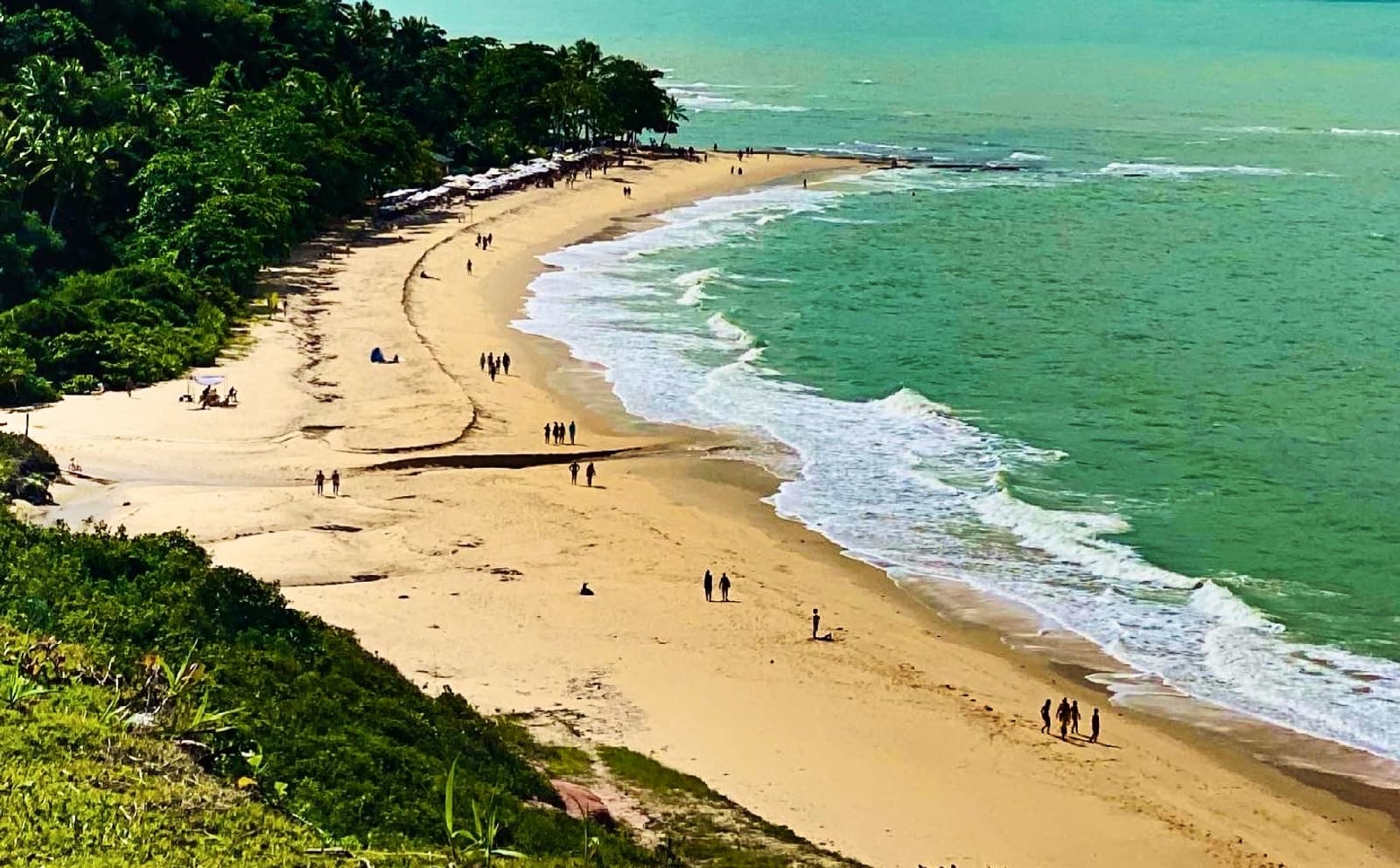
Reddish sandstone cliff and pale sand, one of the most photographed beaches in Arraial, with beach shacks on the sand and an access trail through the forest.
The one closest to the center, linked by Rua do Mucugê, with beach shacks and still water: it is the busiest spot in the village.
Reefs very close to the sand form natural pools at low tide, good for snorkeling and for a quiet swim.
A water park on Mucugê Beach, with water slides and pools: the biggest complex of its kind in the state.
Cliffs and natural pools at low tide, farther away and quieter, between Arraial d'Ajuda and Trancoso.
Brazil is in the Southern Hemisphere, so the seasons run opposite to those in Europe and North America: summer in Arraial d'Ajuda falls between December and March and winter between June and August. The heat lasts all year: in January, the hottest month, the average high is 29 °C, and in July, the coolest month, the high is 26 °C and the low is 19 °C.
There is no clear dry season. The months with the least rain are September (129 mm over 13 days), August (134 mm over 16 days) and May (145 mm over 14 days). The wettest are March (217 mm over 17 days), April (205 mm over 15 days) and June (201 mm over 16 days). From March to July it rains a little more.
That means you can travel to Arraial d'Ajuda in any month, but without expecting guaranteed dry weather, because these are historical averages. The reference climate data is from the Ilhéus station. December to March is high season, with more sun, more heat and more people; outside summer prices drop and the beaches empty out.
| Month | High | Low | Rain | Rainy days | Rating |
|---|---|---|---|---|---|
| January | 29 °C | 22 °C | 151 mm | 15 | Fair |
| February | 29 °C | 22 °C | 182 mm | 15 | Fair |
| March | 29 °C | 22 °C | 217 mm | 17 | Fair |
| April | 29 °C | 22 °C | 205 mm | 15 | Fair |
| May | 28 °C | 21 °C | 145 mm | 14 | Fair |
| June | 26 °C | 20 °C | 201 mm | 16 | Fair |
| July | 26 °C | 19 °C | 201 mm | 18 | Fair |
| August | 26 °C | 19 °C | 134 mm | 16 | Fair |
| September | 26 °C | 20 °C | 129 mm | 13 | Fair |
| October | 28 °C | 21 °C | 147 mm | 13 | Fair |
| November | 28 °C | 22 °C | 146 mm | 14 | Fair |
| December | 29 °C | 22 °C | 179 mm | 13 | Fair |
Monthly averages for 1991-2020 from INMET (Brazil's National Institute of Meteorology). The rating combines rainfall, temperature and humidity.
In summer (December to February), Arraial d'Ajuda has highs of around 29 °C (84 °F) and lows of 22 °C (72 °F), and it is the wetter season, with about 171 mm of rain spread over about 14 days a month. The days are hot and call for beach time and shade.
In fall (March to May), Arraial d'Ajuda has highs of around 29 °C (84 °F) and lows of 22 °C (72 °F), and it is the wetter season, with about 189 mm of rain spread over about 15 days a month. The days are hot and call for beach time and shade.
In winter (June to August), Arraial d'Ajuda has highs of around 26 °C (79 °F) and lows of 19 °C (66 °F), and it is the wetter season, with about 179 mm of rain spread over about 17 days a month. Temperatures are pleasant for sightseeing all day.
In spring (September to November), Arraial d'Ajuda has highs of around 27 °C (81 °F) and lows of 21 °C (70 °F), and it is the wetter season, with about 141 mm of rain spread over about 13 days a month. Temperatures are pleasant for sightseeing all day.
Weather, crowds, prices and what is happening at the destination in each period. Tap a month to open its full page; the colored dot shows how good the time is for a visit.
The village's cultural Carnival, with traditional blocos (street parties) parading along Rua do Mucugê and through the squares.
From August 6 to 15, the sanctuary receives pilgrims (some walk the 68 km from Eunápolis), and the main procession closes the festival.
New Year's Eve brings parties on the beach and on Rua do Mucugê, one of the top New Year's spots in southern Bahia.
Recurring annual events: exact dates change every year, so confirm them before you plan your trip.
The access airport is Porto Seguro International Airport (BPS), about 10 km away, on the Porto Seguro side. From there you cross the Buranhém River by ferry, a crossing of about ten minutes, to Arraial d'Ajuda.
You can also get there without the ferry, along the BR-367 and BA-986 via Eunápolis, on a paved route of about 68 km. By land, it is only 3 km from Porto Seguro (with the ferry crossing), 715 km from Salvador (about 10 h) and 938 km from Belo Horizonte (about 13 h 30 min).
Routes and airlines change often; the safest approach is to check them when planning your trip.
The center and Rua do Mucugê can be covered on foot. Staying near that area lets you walk to the church, the lookout and the nightlife, and the beaches of Mucugê and Parracho sit right next to the center. Taípe, by contrast, is farther away and quieter, between Arraial d'Ajuda and Trancoso. It is best to pick a place to stay near what you most want to visit and to remember that getting here means crossing the river by ferry.
Rates change with the dates: confirm the price on Booking.com.
By car or plane to Porto Seguro (BPS airport) and then by ferry, crossing the Buranhém River in about ten minutes. The car ferry runs 24 hours. You can also get here without the ferry along the BR-367 and BA-986 via Eunápolis, avoiding the line but adding about 68 km.
December to March is high season: more sun, more heat and more people. It rains all year, with no real dry season, and March to July is somewhat wetter. September is the driest month (129 mm). Outside summer prices drop and the beach empties out.
They are neighbors, but with different atmospheres. Arraial has more services, nightlife on Rua do Mucugê and more affordable prices. Trancoso, about 25 km to the south, is more upscale and expensive, with the Quadrado, its central square, as the main hangout. You can stay in one and visit the other in a day.
Two to three days are enough to see the center, the church and the lookout and to alternate between the cliff beaches and those with more services. If you want to extend the trip to Trancoso or Caraíva, you need one or two more days.
Not if you only stay in the village: the center and Rua do Mucugê are walkable, and taxis or ride-hailing apps cover the rest. A car helps if you want to go back and forth to Trancoso and Caraíva without depending on a van, or to bring your own vehicle on the ferry.
It depends on what you are after. Pitinga and Taípe have colorful cliffs and a natural pool at low tide, better for photos and walks. Mucugê and Parracho are next to the center, with beach shacks and services all day, better if you do not want to walk much.
The weather and population data in this guide come from official agencies and open databases. Entry requirements and health recommendations change: always check the official source linked.


