
Japaratinga Natural Pools Boat Tour
On this boat tour in Jarapatinga, we'll sail through the natural pools of this municipality in the state of Alagoas – you'll fall in love with its beauty!
3 h
from US$ 32
Japaratinga calls for 2 to 3 days: for the main beach, the trip to the natural pools and a side trip to Barreiras do Boqueirão or Barra de Camaragibe. From September to March it rains less, and the driest months are December (37 mm over 9 days), November (45 mm over 6 days) and October (70 mm over 10 days), with highs of 30 to 31 °C; from April to July it rains much more, with 323 mm over 24 days in June.
Japaratinga is a fishing village wedged between Maragogi and São Miguel dos Milagres, on the north coast of Alagoas, and it lives a little in the shadow of its more famous neighbor. The sea is the same turquoise blue protected by the reefs of the Costa dos Corais (Coral Coast), but here the crowds are much smaller: sand streets, low houses, a few pousadas (small inns) and a strip of coconut palms that follows the AL-101 highway from end to end. Anyone who has been to Maragogi and found the trip to the Galés (the offshore natural pools) crowded often ends up in Japaratinga looking for the same scenery with fewer people around.
What rules daily life in Japaratinga is the tide, not the clock. When the water drops, the sea pulls back hundreds of meters and exposes natural pools, sandbanks and stretches of reef that are completely submerged at high tide, the same logic as the Galés of Maragogi, but in a smaller, emptier version. The jangada trip (a traditional sailing raft) out to the reefs leaves according to the day's tide table, and much of Japaratinga's charm lies in walking on those sandbanks that appear out of nowhere in the middle of the sea.
It is a destination for people who prefer calm to infrastructure: few restaurants, no organized nightlife and a landscape centered on the main beach, Barreiras do Boqueirão and Barra de Camaragibe, farther north. Taxis, transport and food options are scarcer than in Maragogi. It pays off for anyone willing to accept that extra effort in exchange for an almost untouched fishing village.
Updated on October 19, 2026
Pools formed over the reefs a few minutes from the shore, with shallow, clear water over corals and colorful fish, visible only at low tide. You get there by jangada or catamaran, with a snorkeling stop timed to the day's tide table.
The village's main beach, with pale sand and coconut palms, calm water protected by the reefs and a few beachfront kiosks.
About 5 km from the center, it has natural pools right in front of the sand, small colorful cliffs and the largest concentration of kiosks in the area.
A beach where the Camaragibe River meets the sea, farther north, with calm water, mangrove and coconut grove. It is one of the most popular day trips from Japaratinga.
A sandbank that emerges in the middle of the sea at low tide, inside the Costa dos Corais Environmental Protection Area; you can walk out to it from the beach.
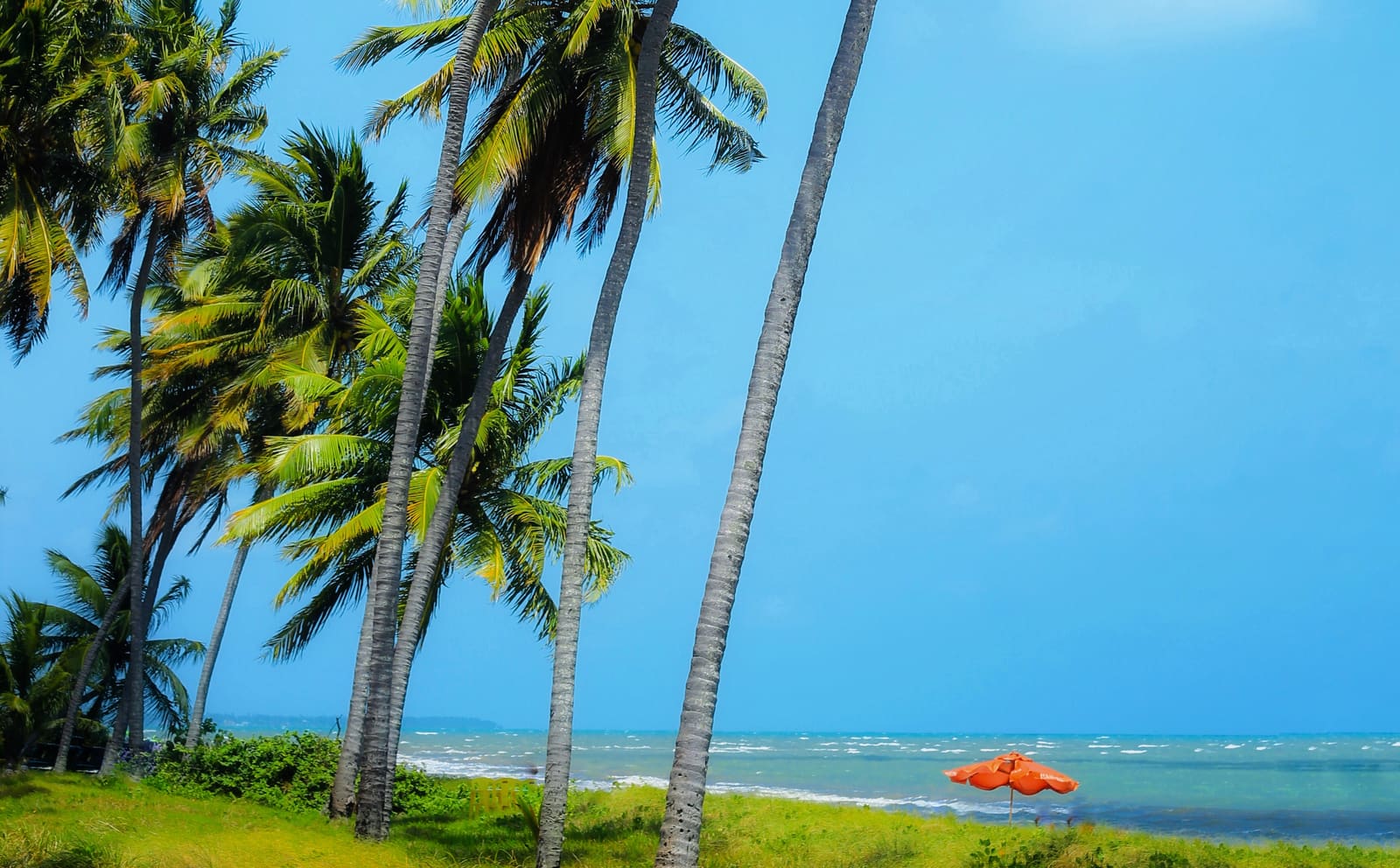
The road linking Japaratinga with Maragogi and São Miguel dos Milagres runs lined with coconut palms for kilometers, one of the postcard scenes of the north coast of Alagoas.
Brazil is in the Southern Hemisphere, so the seasons are the reverse of those in Europe and North America: summer falls between December and March and winter between June and August. In Japaratinga the heat is constant: highs are 31 to 32 °C from December to March, and winter is mild; from June to August, the coolest months, the average high is 28 °C and the low is 20 °C. The reference climate is that of the Maceió station, the nearest one.
The rain does change a lot. December is the month with the least rain, with 37 mm over 9 days, followed by November (45 mm over 6 days) and October (70 mm over 10 days). June is the wettest, with 323 mm over 24 days, followed by May (295 mm over 22 days) and July (271 mm over 23 days).
For reef trips, the best window runs from October to December, and from September to March there is less rain and the sea tends to be calmer. But what defines the trip is not the season but the low tide: without it, the natural pools do not appear.
| Month | High | Low | Rain | Rainy days | Rating |
|---|---|---|---|---|---|
| January | 31 °C | 21 °C | 91 mm | 10 | Fair |
| February | 31 °C | 22 °C | 80 mm | 11 | Fair |
| March | 32 °C | 22 °C | 101 mm | 17 | Not recommended |
| April | 31 °C | 22 °C | 194 mm | 19 | Fair |
| May | 30 °C | 21 °C | 295 mm | 22 | Fair |
| June | 28 °C | 20 °C | 323 mm | 24 | Fair |
| July | 28 °C | 20 °C | 271 mm | 23 | Fair |
| August | 28 °C | 20 °C | 192 mm | 19 | Fair |
| September | 29 °C | 20 °C | 109 mm | 15 | Fair |
| October | 30 °C | 20 °C | 70 mm | 10 | Fair |
| November | 31 °C | 21 °C | 45 mm | 6 | Good |
| December | 31 °C | 21 °C | 37 mm | 9 | Good |
Monthly averages for 1991-2020 from INMET (Brazil's National Institute of Meteorology). The rating combines rainfall, temperature and humidity.
In summer (December to February), Japaratinga has highs of around 31 °C (88 °F) and lows of 21 °C (70 °F), and it is the driest time of year, with about 69 mm of rain a month. The days are hot and call for beach time and shade.
In fall (March to May), Japaratinga has highs of around 31 °C (88 °F) and lows of 22 °C (72 °F), and it is the wetter season, with about 197 mm of rain spread over about 19 days a month. The days are hot and call for beach time and shade.
In winter (June to August), Japaratinga has highs of around 28 °C (82 °F) and lows of 20 °C (68 °F), and it is the wetter season, with about 262 mm of rain spread over about 22 days a month. The days are hot and call for beach time and shade.
In spring (September to November), Japaratinga has highs of around 30 °C (86 °F) and lows of 20 °C (68 °F), and it is the wetter season, with about 75 mm of rain spread over about 10 days a month. The days are hot and call for beach time and shade.
Weather, crowds, prices and what is happening at the destination in each period. Tap a month to open its full page; the colored dot shows how good the time is for a visit.
The patron saint is celebrated with a novena (nine days of prayer), a procession and a party on the waterfront, at the height of the summer season.
The town's political emancipation is commemorated on June 23, with a civic parade and concerts.
New Year's Eve brings concerts on the waterfront in the last days of the year, in one of the biggest events on the local calendar.
Recurring annual events: exact dates change every year, so confirm them before you plan your trip.
The nearest airport is Zumbi dos Palmares International Airport (MCZ), in Maceió, about 122 km away. The alternative is Recife/Guararapes International Airport (REC), in Recife, about 146 km away.
Along the AL-101, the drive takes about 2 hours from Maceió (122 km) and about 2 hours 30 minutes from Recife (146 km). Maragogi is 11 km away, about 15 minutes. The last hour of the journey is usually done by van or a transfer arranged with the pousada. Routes and airlines change often; the safest approach is to check them when you plan your trip.
Japaratinga is small, with few pousadas, and the village is covered on foot; the neighboring beaches, such as Barreiras do Boqueirão and Barra de Camaragibe, are a few kilometers away, and taxi service is limited. Another option is to stay in Maragogi, 11 km away, which offers more variety in food and evening plans without giving up Japaratinga's quiet beach during the day.
Rates change with the dates: confirm the price on Booking.com.
From September to March the weather is drier and the sea calmer, the best window for trips to the natural pools; the three months with the least rain are December, November and October. From April to July it rains more, with peaks in May and June. The heat is constant all year.
They form over the reefs at low tide, when the sea pulls back and leaves the water shallow and crystal clear. The jangada trip to the reefs follows the day's tide table, not a fixed schedule; it is worth confirming the tide before booking the trip.
Two to three days is enough for the main beach, the trip to the natural pools and a side trip to Barreiras do Boqueirão or Barra de Camaragibe. It is a small destination, without many activities to fill your schedule.
The two sit side by side and have the same kind of sea and reefs. Maragogi is bigger, with more pousadas, restaurants and trip options; Japaratinga is a much smaller, quieter village, with its own natural pools and sandbanks and far fewer people.
It helps quite a bit. The village itself is small and walkable, but the neighboring beaches (Barreiras do Boqueirão, Barra de Camaragibe) are a few kilometers away and taxi service is limited. A rental car or buggy gives you the freedom to explore the area.
Yes. In the natural pools and along much of the main beach, protected by the reefs, the sea is shallow and calm at low tide, similar to what Maragogi offers, but with far fewer people around.
The weather and population data in this guide come from official agencies and open databases. Entry requirements and health recommendations change: always check the official source linked.