
9· 6 reviews
Búzios Day Trip
On this day trip to Búzios, we'll sail on a traditional-style ship along the paradise beaches of Rio de Janeiro and enjoy a delicious lunch by the sea.
6 h
from US$ 46
Cabo Frio calls for 3 to 4 days: Praia do Forte, the beaches and dunes of Peró, a trip along the Canal do Itajuru and day trips to neighboring Búzios and Arraial do Cabo. The window with the best conditions runs from April to September, with August as the best month (36 mm of rain over 5 days and highs of 26 °C). Summer is hotter (up to 32 °C in January) and rain peaks in November, December and March, at 109 to 112 mm each month.
Cabo Frio ("Cold Cape") is well named: here the ocean is colder than along the rest of the Rio coast, because of an upwelling phenomenon that pushes deep water toward the surface and leaves the sea a crystal-clear blue that is rare in the Southeast. In the Região dos Lagos, the city combines one of the whitest and finest sands in Brazil, at Praia do Forte, with a historic center that holds the 17th-century Forte São Mateus. It is a postcard beach two and a half hours from Rio.
Cabo Frio is one of the driest areas on the Southeast coast: the same upwelling that cools the sea suppresses rain, and the city receives less than 900 mm a year. Summer, from December to March, is hot, sunny and crowded; winter, from June to August, is mild and windy, with colder sea. The steady wind also makes the region well known among kitesurfers. It is one of the most reliable beach destinations for sun all year round.
The heart of Cabo Frio is Praia do Forte, with its white sand and its seafront promenade. Around it, the variety is impressive: Praia das Conchas and Peró, more sheltered; the white dunes of Peró, a spot for sandboarding and sunset; and the Canal do Itajuru, which links the Araruama lagoon to the sea, with the shallow, warm waters of Ilha do Japonês. In the center are the Forte São Mateus and the Praça das Águas. It is a beach for all kinds of travelers, easy to combine with Búzios and Arraial do Cabo, right next door.
Updated on October 19, 2026
The city's busiest beach, with a long strip of fine white sand and clear sea water.
A sheltered beach with calm water, set among rocks and surrounded by coastal scrub and trails.
A long open-sea beach with preserved dunes, good for walking and kitesurfing.
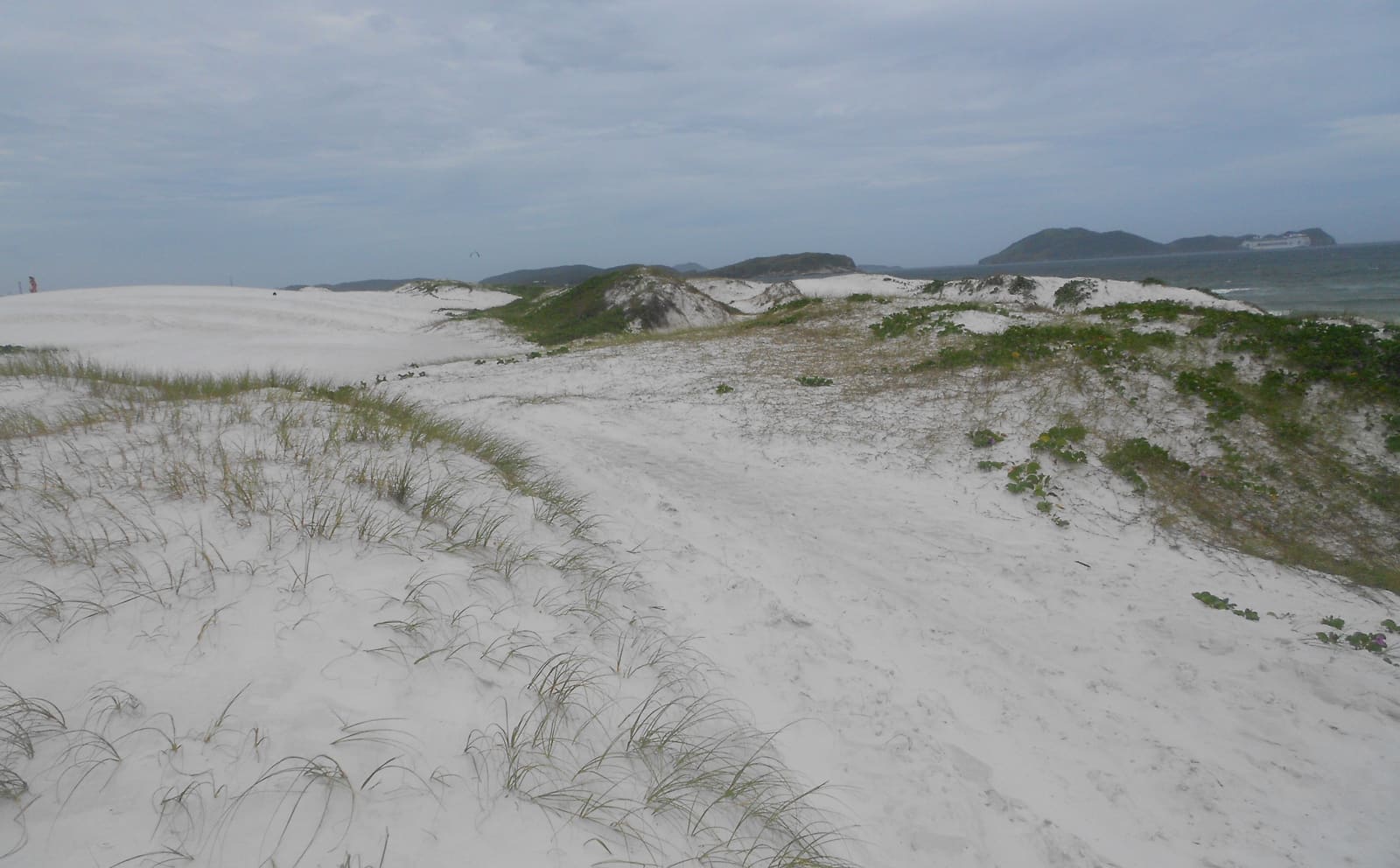
A field of white-sand dunes inside a conservation area, a classic for sandboarding and sunset.
A channel linking the Araruama lagoon to the sea, with a waterside promenade, boat trips and calm water right in the center.
A 17th-century fortress built on the rocks at the mouth of the channel to defend against privateers.
A square beside the channel with fountains and lit water displays, a meeting point at night.
A small island of shallow, warm water inside the channel, reachable on foot at low tide or by kayak.
Brazil is in the Southern Hemisphere, so the seasons are the reverse of those in Europe and North America: summer in Cabo Frio falls between December and March and winter between June and August. In January and February, the hottest months, the average high is 32 °C. In June, July and August, the coolest, the high is 26 °C and the low is 18 °C, so winter is mild.
It is one of the driest areas on the coast. August is the driest month, with 36 mm of rain spread over 5 days; it is followed by June (41 mm over 5 days) and July (53 mm over 6 days). The wettest are November and December, with 112 mm each (over 10 and 9 days), and March, with 109 mm over 8 days.
In terms of weather, the best window to visit runs from April to September, with August as the best month. Keep in mind that the upwelling leaves the water colder than along the rest of the Rio coast, and that on days with a southerly wind the temperature drops even further: bear that in mind if you plan to swim. From December to March the city is warm, sunny and full. These are multi-year averages, not a guarantee for your dates. The reference climate data comes from the neighboring station of Iguaba Grande.
| Month | High | Low | Rain | Rainy days | Rating |
|---|---|---|---|---|---|
| January | 32 °C | 23 °C | 104 mm | 8 | Fair |
| February | 32 °C | 24 °C | 61 mm | 6 | Good |
| March | 31 °C | 23 °C | 109 mm | 8 | Good |
| April | 29 °C | 22 °C | 65 mm | 6 | Good |
| May | 27 °C | 19 °C | 75 mm | 7 | Good |
| June | 26 °C | 18 °C | 41 mm | 5 | Very good |
| July | 26 °C | 18 °C | 53 mm | 6 | Good |
| August | 26 °C | 18 °C | 36 mm | 5 | Very good |
| September | 27 °C | 19 °C | 62 mm | 7 | Good |
| October | 28 °C | 20 °C | 65 mm | 8 | Good |
| November | 28 °C | 21 °C | 112 mm | 10 | Good |
| December | 30 °C | 23 °C | 112 mm | 9 | Fair |
Monthly averages for 1991-2020 from INMET (Brazil's National Institute of Meteorology). The rating combines rainfall, temperature and humidity.
In summer (December to February), Cabo Frio has highs of around 31 °C (88 °F) and lows of 23 °C (73 °F), and it is the wetter season, with about 92 mm of rain spread over about 8 days a month. The days are hot and call for beach time and shade.
In fall (March to May), Cabo Frio has highs of around 29 °C (84 °F) and lows of 21 °C (70 °F), and it is the wetter season, with about 83 mm of rain spread over about 7 days a month. The days are hot and call for beach time and shade.
In winter (June to August), Cabo Frio has highs of around 26 °C (79 °F) and lows of 18 °C (64 °F), and it is the driest time of year, with about 43 mm of rain a month. Temperatures are pleasant for sightseeing all day.
In spring (September to November), Cabo Frio has highs of around 28 °C (82 °F) and lows of 20 °C (68 °F), and it is the wetter season, with about 80 mm of rain spread over about 8 days a month. The days are hot and call for beach time and shade.
Weather, crowds, prices and what is happening at the destination in each period. Tap a month to open its full page; the colored dot shows how good the time is for a visit.
Street blocos (street parties) and celebrations on the waterfront and in the historic center during the Carnival holiday.
New Year's Eve at Praia do Forte, with concerts and fireworks. It is one of the biggest New Year's Eve celebrations in the Lakes Region.
Recurring annual events: exact dates change every year, so confirm them before you plan your trip.
The most commonly used gateway from abroad is Tom Jobim International Airport, known as Galeão (GIG), in Rio de Janeiro, about 155 km from Cabo Frio. Cabo Frio also has its own international airport (CFB), about 5 km from the city, but with seasonal flights and few regular ones; Galeão and Santos Dumont (SDU) have the widest choice.
From Rio, the overland route is 155 km along the Via Lagos (RJ-124), about 2 h by car; you can also continue by road transfer. From São Paulo it is 574 km, about 7 h.
Routes and airlines change often; the safest approach is to check them when planning your trip.
For Praia do Forte and the center you don't need a car: you can manage on foot and by ride-hailing app. A car helps for the more distant beaches, such as Peró and Conchas, and for day trips to Búzios and Arraial do Cabo. Cabo Frio is the largest and best-equipped of the three cities in the Região dos Lagos and has a good network of hotels and pousadas (small inns).
Rates change with the dates: confirm the price on Booking.com.
April to September is the window with the best conditions; August is the best month, with 36 mm of rain and highs of 26 °C. Summer, from December to March, is warm, sunny and crowded. Cabo Frio is one of the driest areas on the coast, so the sun is reliable almost all year; winter is mild and windy, with colder sea.
Because of upwelling: the winds push warm surface water away from the coast and bring up cold, deep water. That leaves the sea colder than along the rest of the Rio coast and, at the same time, a crystal-clear blue, because it is cleaner and richer in nutrients.
Three to four days are enough to enjoy Praia do Forte, see the beaches and dunes of Peró, stroll along the Canal do Itajuru and still make day trips to neighboring Búzios and Arraial do Cabo.
They sit side by side in the Região dos Lagos and complement each other. Cabo Frio is the largest and best-equipped, with the iconic Praia do Forte; Búzios is the most charming and lively; Arraial do Cabo has the most paradisiacal beaches, with transparent water. You can combine all three in one trip.
For Praia do Forte and the center, no: you can walk and use a ride-hailing app. A car helps for the more distant beaches, such as Peró and Conchas, and for day trips to Búzios and Arraial do Cabo.
Yes, thanks to its facilities: Praia do Forte has a promenade, kiosks and sea for swimming, and Ilha do Japonês, in the channel, has shallow, warm water, great for children. The city has a good network of hotels and pousadas.
The weather and population data in this guide come from official agencies and open databases. Entry requirements and health recommendations change: always check the official source linked.


