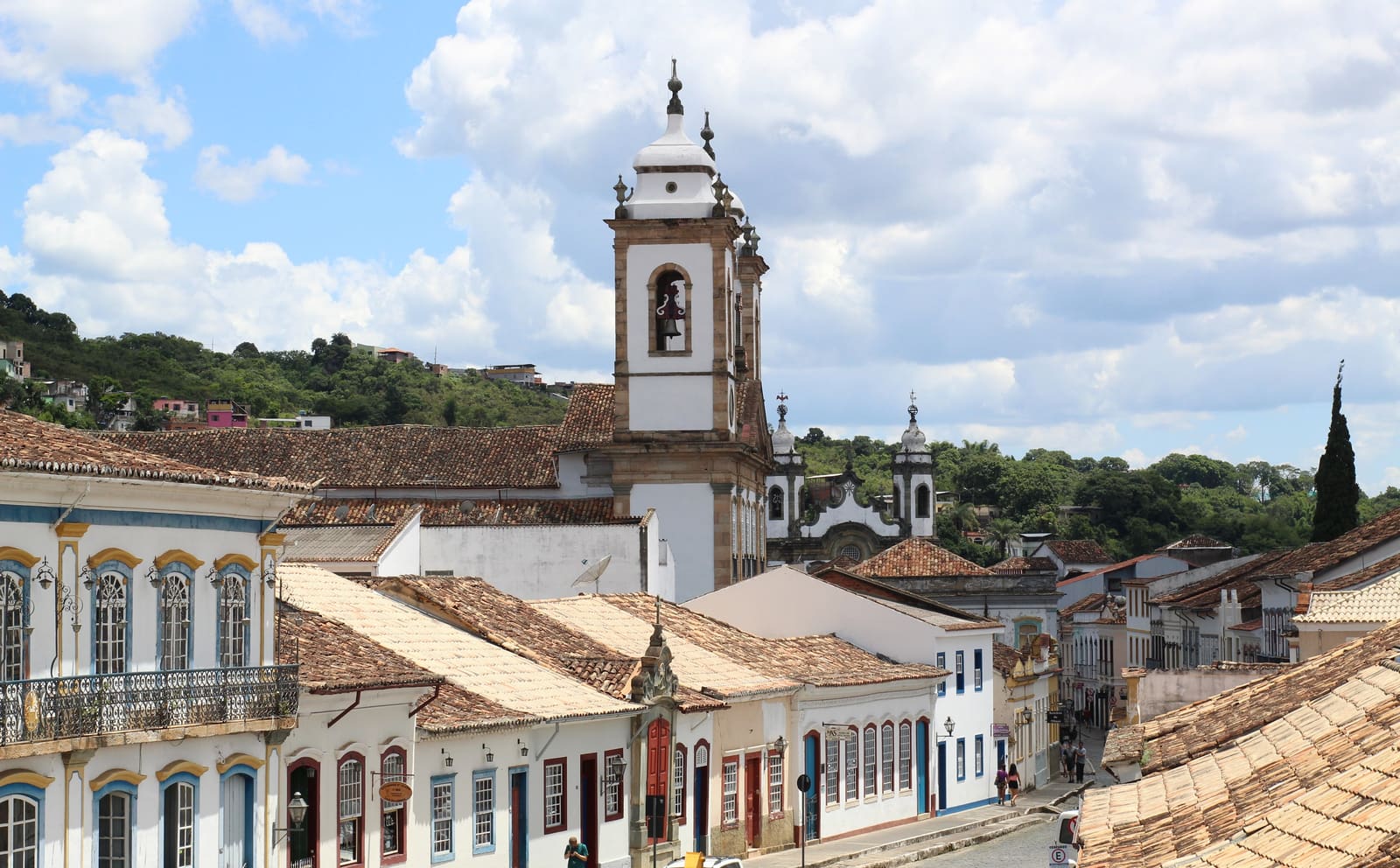
São João del-Rei is worth 1 to 2 days: enough for the main churches, the Railway Museum and the Tancredo Neves Memorial, plus a ride on the steam train to Tiradentes. The driest months run from May to September, with highs of 24 to 26 °C and lows down to 10 °C in June and July; summer, from December to March, is rainier (327 mm in December).
What to expect in São João del-Rei
São João del-Rei began as a mining village in the early 18th century, but it grew well beyond gold: it became a crossroads for mule drivers and, in 1881, the seat of the first railway in Minas Gerais, the Estrada de Ferro Oeste de Minas, opened with Dom Pedro II in attendance. That wealth lives on in Baroque architecture: the Church of São Francisco de Assis, with a facade designed by Aleijadinho, was described by the English traveler Richard Burton as the most spectacular in all of Minas Gerais, and the Cathedral Basilica of Nossa Senhora do Pilar, built in 1721, holds one of the richest colonial interiors in the region.
At almost 900 meters above sea level, the city has the mild mountain climate typical of the Campo das Vertentes: a warm, rainy summer from December to March, with heavy afternoon downpours, and a dry, cool winter from June to August, with sunny days and nights that call for a jacket. A low of around 10 °C is not unusual. The dry season, from May to September, is the most pleasant time to walk the historic center and visit the churches without rain spoiling your plans.
Tancredo Neves was born here in 1910 and lived here for much of his life, at the Solar dos Neves on the Largo do Rosário. Today his story is told at the memorial that bears his name, in an 18th-century mansion in the center. Unlike neighboring Tiradentes, which lives almost entirely on tourism, São João del-Rei carries on with everyday life: it has a federal university, real shops and people heading to work. It is bigger, more spread out and a little less polished for visitors, but also cheaper and less picture-perfect. The steam train (the Maria Fumaça), which dates from 1881, links the two towns, over 12 km of track between the Rio das Mortes and the Serra de São José, and it is worth setting aside one day for each.
Updated on October 19, 2026
Must-sees in São João del-Rei
Church of São Francisco de Assis
Baroque facade designed by Aleijadinho and built from 1774 onward: the English traveler Richard Burton called it the most spectacular in all of Minas Gerais.
Cathedral Basilica of Nossa Senhora do Pilar
Built in 1721 by the Brotherhood of the Blessed Sacrament, it has been a cathedral since 1960 and a basilica since 1965, with one of the richest colonial interiors in the city.
Steam train to Tiradentes
A steam locomotive from the old Estrada de Ferro Oeste de Minas railway that covers 12 km of track to Tiradentes, running alongside the Rio das Mortes.
Railway Museum
Housed in the railway complex dating from 1881, it holds EFOM locomotive no. 1, period carriages and the roundhouse turntable that still rotates the steam engines.
Largo do Rosário
A square in front of the Church of Nossa Senhora do Rosário, built by the oldest Black brotherhood in Minas Gerais, and the Solar dos Neves.
Solar dos Neves
A 19th-century mansion where Tancredo Neves lived between 1957 and 1985, still owned by the family; only the facade can be visited, and it is one of the city's postcard views.
Ponte da Cadeia
A stone bridge from 1798, built in cut stone after the old wooden bridge collapsed during a procession, with a stone cross at its center.
Tancredo Neves Memorial
An 18th-century mansion turned museum on the life of the politician from São João del-Rei who would have been the first civilian president after the dictatorship, but died before taking office.
Best time to visit São João del-Rei
Brazil is in the Southern Hemisphere, so the seasons are the reverse of those in Europe and North America: summer falls between December and March and winter between June and August. Because of the altitude (898 m), winter is cool: in June and July, the coldest months, the average high is 24 °C and the low is 10 °C. The hottest month is February, with an average high of 29 °C.
Rain is concentrated in summer. December is the rainiest month, with 327 mm over 18 days, followed by January (320 mm over 17 days) and November (196 mm over 13 days). The driest months are July, with 12 mm over 2 days, June, with 15 mm over 2 days, and August, with 22 mm over 3 days.
The best window for walking the historic center is from May to September, with July the driest month. In those months the days are usually sunny, but the nights are cool, so bring a jacket. In summer, by contrast, afternoon downpours can disrupt your plans.
| Month | High | Low | Rain | Rainy days | Rating |
|---|---|---|---|---|---|
| January | 28 °C | 17 °C | 320 mm | 17 | Fair |
| February | 29 °C | 17 °C | 184 mm | 12 | Fair |
| March | 28 °C | 17 °C | 193 mm | 11 | Fair |
| April | 27 °C | 15 °C | 65 mm | 6 | Good |
| May | 25 °C | 12 °C | 41 mm | 4 | Very good |
| June | 24 °C | 10 °C | 15 mm | 2 | Very good |
| July | 24 °C | 10 °C | 12 mm | 2 | Very good |
| August | 25 °C | 11 °C | 22 mm | 3 | Very good |
| September | 26 °C | 13 °C | 78 mm | 6 | Very good |
| October | 27 °C | 15 °C | 129 mm | 9 | Good |
| November | 27 °C | 16 °C | 196 mm | 13 | Fair |
| December | 27 °C | 17 °C | 327 mm | 18 | Fair |
Monthly averages for 1991-2020 from INMET (Brazil's National Institute of Meteorology). The rating combines rainfall, temperature and humidity.
The weather in São João del-Rei, season by season
In summer (December to February), São João del-Rei has highs of around 28 °C (82 °F) and lows of 17 °C (63 °F), and it is the wetter season, with about 277 mm of rain spread over about 16 days a month. The days are hot and call for beach time and shade.
In fall (March to May), São João del-Rei has highs of around 27 °C (81 °F) and lows of 15 °C (59 °F), and it is the wetter season, with about 100 mm of rain spread over about 7 days a month. Temperatures are pleasant for sightseeing all day.
In winter (June to August), São João del-Rei has highs of around 24 °C (75 °F) and lows of 10 °C (50 °F), and it is the driest time of year, with about 16 mm of rain a month. The weather is milder, good for walking and exploring without the summer heat.
In spring (September to November), São João del-Rei has highs of around 27 °C (81 °F) and lows of 15 °C (59 °F), and it is the wetter season, with about 134 mm of rain spread over about 9 days a month. Temperatures are pleasant for sightseeing all day.
São João del-Rei in every month of the year
Weather, crowds, prices and what is happening at the destination in each period. Tap a month to open its full page; the colored dot shows how good the time is for a visit.
Recurring events in São João del-Rei
Holy Week (Semana Santa)
One of the most traditional celebrations in Minas Gerais, with the Ofício de Trevas (Tenebrae service), the Combate dos Sinos (a duel of church bells) and street carpets across the historic center.
UFSJ Cultural Winter (Inverno Cultural da UFSJ)
One of the biggest art and culture festivals in Minas Gerais, with free concerts, workshops and performances spread across the city.
Feast of Our Lady of the Pillar (Festa de Nossa Senhora do Pilar)
The city's patron saint, celebrated on October 12 with a solemn Mass and a procession through the streets of the center.
Recurring annual events: exact dates change every year, so confirm them before you plan your trip.
Getting to São João del-Rei from abroad
The nearest airport is Tancredo Neves International Airport in Confins (CNF), near Belo Horizonte, about 230 km from São João del-Rei.
The rest of the trip is by road. From Belo Horizonte, São João del-Rei is 186 km away (about 2 h 40 min) via the BR-040 and BR-265; from Rio de Janeiro it is 336 km (about 4 h 30 min), and from São Paulo 471 km (about 5 h 30 min). The city has its own bus station.
Routes and airlines change often, so it is safest to check them when you plan your trip.
Hotels in São João del-Rei
The historic center is best explored on foot, so it pays to stay close to it. The city is bigger and more spread out than Tiradentes or Ouro Preto, so if you stay farther from the center you will probably need a car or other transport. Since Tiradentes is only 12 km away, you can also sleep in one town and visit the other; the steam train connects them.
Rates change with the dates: confirm the price on Booking.com.
Practical information for visitors from abroad
Frequently asked questions about São João del-Rei
What is the best time to visit São João del-Rei?
The dry season, from May to September, brings sunny days and little rain, ideal for walking the historic center. In October the festival of the patron saint, Nossa Senhora do Pilar, takes place, and in July the UFSJ Inverno Cultural, with a program of concerts and exhibitions.
How many days do you need in São João del-Rei?
One to two days is enough to see the main churches, the Railway Museum and the Tancredo Neves Memorial, with time left for a ride on the steam train to Tiradentes.
São João del-Rei or Tiradentes?
They are neighboring, complementary towns. Tiradentes is smaller, more polished for tourists and concentrated in a few blocks. São João del-Rei is bigger, with a life of its own, a university and shops, cheaper and less picture-perfect, but with churches as rich as its neighbor's.
How does the steam train between São João del-Rei and Tiradentes work?
It is a steam locomotive that covers about 12 km between the two towns, running alongside the Rio das Mortes. It usually operates Thursday to Sunday and on public holidays; it is best to confirm the schedule and buy your ticket in advance.
Where is Tancredo Neves's house in São João del-Rei?
The president-elect who died before taking office was born in the city in 1910 and lived at the Solar dos Neves, on the Largo do Rosário, which can only be seen from the outside today. His political career is told at the Tancredo Neves Memorial, in an 18th-century mansion in the historic center.
Do you need a car in São João del-Rei?
The historic center can be covered on foot, but the city is bigger and more spread out than Tiradentes or Ouro Preto: a car helps for getting there and for going beyond the center. To combine it with Tiradentes, the steam train works too.
Other destinations in Brazil
The weather and population data in this guide come from official agencies and open databases. Entry requirements and health recommendations change: always check the official source linked.