
8.7· 138 reviews
São José dos Pinhais Wine Tour
Want to discover the winemaking tradition of the state of Paraná? We'll follow the São José dos Pinhais wine route, of 4 wineries including wine tasting.
6 h
from US$ 31
Curitiba calls for 3 to 4 days: the Oscar Niemeyer Museum, the Ópera de Arame, the Botanical Garden, the Largo da Ordem and the parks. The mildest seasons run from September to November and from March to May, with highs of 21 to 26 °C; winter, from June to August, is the coldest, with average lows of 9.3 to 10.3 °C.
Curitiba became a town on March 29, 1693, when the settlement that had grown around the gold rush and, later, around tropeirismo (the passage of cattle herds from Rio Grande do Sul to São Paulo) was formalized. The big jump in population came after 1870, with waves of European immigrants. The Poles formed the largest colony in Brazil, remembered today in the Bosque do Papa (Pope's Woods), and the Italians founded Santa Felicidade in 1878. Ukrainians and Germans arrived in the same wave and also left their mark on neighborhoods, festivals and food. Today Curitiba is the capital of the state of Paraná, with 1,773,718 inhabitants according to the 2022 Census.
The city sits at about 935 meters above sea level and has the coldest climate among Brazil's capitals: frost is not rare in winter, and even in summer the nights get cool. It is also a benchmark for urban planning. The bi-articulated buses, tube-shaped stations and dedicated lanes of the Integrated Transit Network were created starting in the 1970s, under the administration of the architect and mayor Jaime Lerner. Parks such as Tanguá and Barigui were born from restored old quarries.
What captivates visitors is the mix of architecture, greenery and immigrant memory. The Oscar Niemeyer Museum, nicknamed the Eye Museum for the shape of its annex, and the Ópera de Arame, a tubular-structure theater built in 75 days inside a park, are the most photographed spots. At the Largo da Ordem, a historic center of 18th- and 19th-century townhouses, the Sunday fair has gathered crafts and street food for decades. The European heritage is on the plate too: from the wine and polenta of Santa Felicidade to the pierogi (filled dumplings) of Polish families. Curitiba has no beach and no tropical climate, but it does have enough cultural and dining life to fill several days.
Updated on October 13, 2026
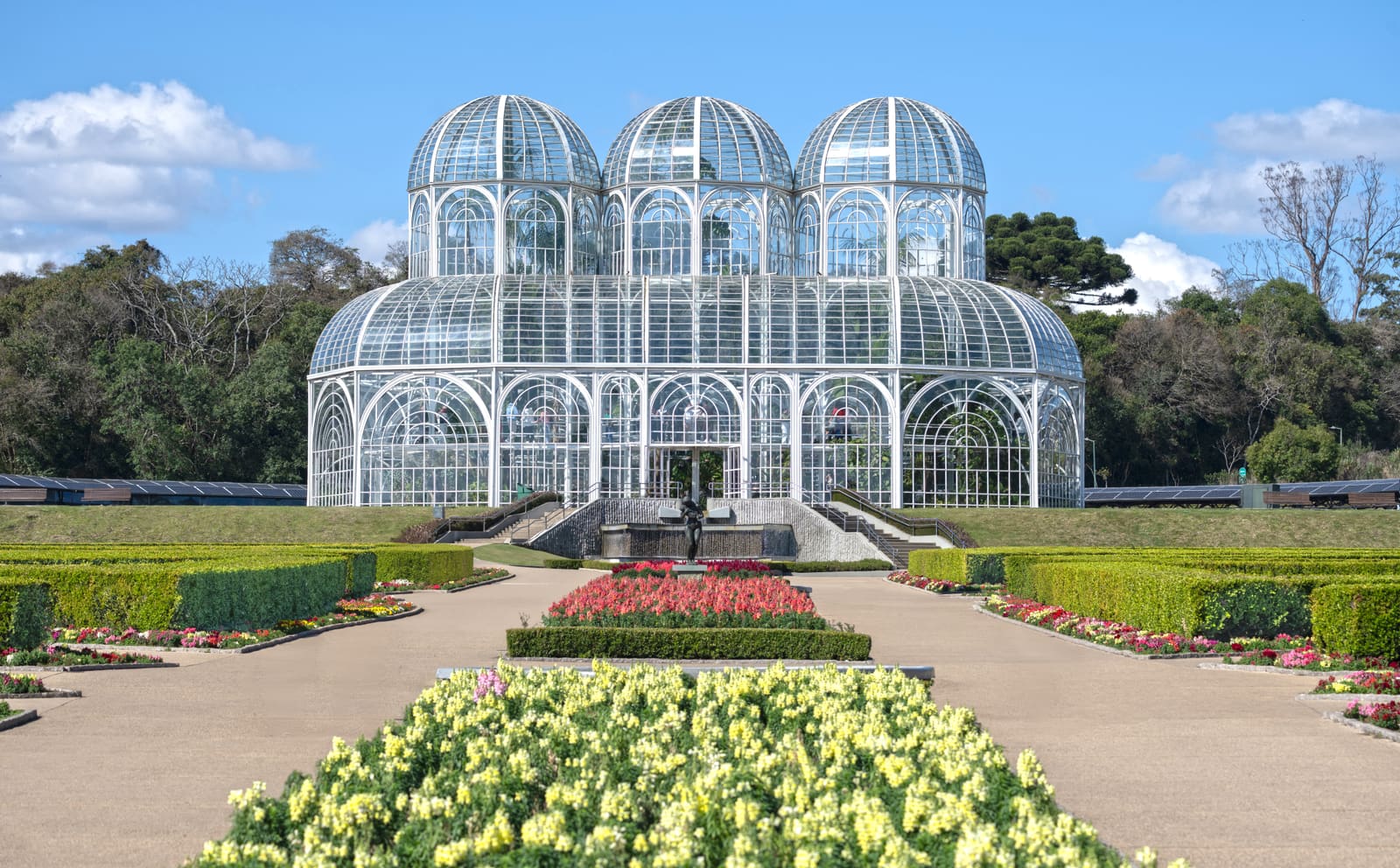
A 245,000 m² park opened in 1991, with an Art Nouveau-style glass greenhouse designed by Abrão Assad and inspired by London's Crystal Palace.
A theater with a tubular metal structure built in 75 days and opened in 1992, inside the Parque das Pedreiras, with the seating area over a lake.
Known as the Eye Museum for the shape of the annex designed by Oscar Niemeyer, it reopened under its current name in 2003 and brings together Brazilian and international visual arts, with works by Tarsila do Amaral and Portinari.
A 235,000 m² park built in 1996 on a former dolomite quarry, with a 65-meter viewpoint over the pit, an artificial waterfall and a tunnel cut into the rock.
A park opened in 1996 in honor of German immigrants, with the 15-meter Philosophers' Tower and the Hansel and Gretel trail, based on the Brothers Grimm tale.
A historic center with 18th- and 19th-century townhouses, now home to bars, galleries and restaurants. On Sundays the Largo da Ordem fair takes place, one of the largest craft fairs in the country, dating from the late 1960s.
A stretch of Rua XV de Novembro closed to traffic in 1972, one of the first pedestrian streets in Brazil and today the hub of shops, cafés and street performances downtown.
Brazil is in the Southern Hemisphere, so the seasons are the reverse of those in Europe and North America: summer in Curitiba falls between December and March and winter between June and August. In summer, average highs range from 26.1 to 27.2 °C and lows from 16.7 to 17.8 °C. In winter, July is the coldest month, with a high of 20.1 °C and a low of 9.3 °C, and occasional frost is possible.
Curitiba has no beach season to wait for, so any month works, but it pays to always bring a coat. The mildest days tend to fall from September to November and from March to May: in October, for example, the high is 23.7 °C and the low is 13.9 °C. August is the driest month, with 81.5 mm of rain over 6 days; January is the wettest, with 226.3 mm over 15 days, followed by February with 188.7 mm over 13 days.
| Month | High | Low | Rain | Rainy days | Rating |
|---|---|---|---|---|---|
| January | 27 °C | 18 °C | 226 mm | 15 | Fair |
| February | 27 °C | 18 °C | 189 mm | 13 | Fair |
| March | 26 °C | 17 °C | 151 mm | 12 | Fair |
| April | 24 °C | 15 °C | 88 mm | 7 | Good |
| May | 21 °C | 12 °C | 96 mm | 8 | Good |
| June | 20 °C | 10 °C | 112 mm | 7 | Good |
| July | 20 °C | 9 °C | 106 mm | 7 | Good |
| August | 22 °C | 10 °C | 82 mm | 6 | Good |
| September | 22 °C | 12 °C | 143 mm | 9 | Good |
| October | 24 °C | 14 °C | 161 mm | 11 | Fair |
| November | 25 °C | 15 °C | 126 mm | 10 | Good |
| December | 27 °C | 17 °C | 152 mm | 12 | Fair |
Monthly averages for 1991-2020 from INMET (Brazil's National Institute of Meteorology). The rating combines rainfall, temperature and humidity.
In summer (December to February), Curitiba has highs of around 27 °C (81 °F) and lows of 17 °C (63 °F), and it is the wetter season, with about 189 mm of rain spread over about 13 days a month. Temperatures are pleasant for sightseeing all day.
In fall (March to May), Curitiba has highs of around 24 °C (75 °F) and lows of 14 °C (57 °F), and it is the wetter season, with about 112 mm of rain spread over about 9 days a month. The weather is milder, good for walking and exploring without the summer heat.
In winter (June to August), Curitiba has highs of around 21 °C (70 °F) and lows of 10 °C (50 °F), and it is the wetter season, with about 100 mm of rain spread over about 7 days a month. The weather is milder, good for walking and exploring without the summer heat.
In spring (September to November), Curitiba has highs of around 24 °C (75 °F) and lows of 14 °C (57 °F), and it is the wetter season, with about 143 mm of rain spread over about 10 days a month. The weather is milder, good for walking and exploring without the summer heat.
Weather, crowds, prices and what is happening at the destination in each period. Tap a month to open its full page; the colored dot shows how good the time is for a visit.
One of the country's biggest theater festivals takes over dozens of stages across the city for two weeks, with performances, a fringe showcase and concerts.
Largo da Ordem and the surrounding area host outdoor music, theater and circus at the height of Curitiba's cold.
From late November through December, the city fills with lights, choirs and performances, the most traditional of them at the Ópera de Arame.
Recurring annual events: exact dates change every year, so confirm them before you plan your trip.
The gateway from abroad is Afonso Pena International Airport (CWB), in São José dos Pinhais, about 18 km from downtown Curitiba. There is an executive bus and public transit lines into the city.
Routes and the airlines flying to Curitiba change often; the safest approach is to check them when planning your trip. Within the city, the Integrated Transit Network, with bi-articulated buses and tube-shaped stations, covers a good part of the territory and lets you do without a car if you stay in the central area.
If you are not renting a car, the most practical choice is to stay in the central area, because the transit network covers downtown and the main parks well, and it avoids long trips. Plan your itinerary by area: the historic center with the Largo da Ordem, the Botanical Garden and its surroundings, and the string of parks (Tanguá, Barigui and Tingui).
Rates change with the dates: confirm the price on Booking.com.
There is no beach season to wait for, so any month works, but the city is cool all year. From September to November and from March to May the days are milder, with highs of 21 to 26 °C. Winter, from June to August, is the coldest period, with occasional frost.
Three to four days are enough to see the Oscar Niemeyer Museum, the Ópera de Arame, the Botanical Garden and the Largo da Ordem at a relaxed pace. If you want to add a day trip, such as Morretes or the Estrada da Graciosa, you need one more day.
Afonso Pena International Airport (CWB) is in São José dos Pinhais, about 18 km from downtown. There is an executive bus and public transit lines into the city.
It is the coldest capital in Brazil. It sits at about 935 meters above sea level, has an oceanic climate and frost is common in winter. In July the average low is 9.3 °C, and even in summer the nights get cool, so it pays to bring a coat at any time of year.
It is not required. The Integrated Transit Network, with bi-articulated buses and tube-shaped stations, covers downtown and the main parks well. A car helps if you want to visit several outlying parks on the same day.
The immigrant heritage is on the plate: pasta and wine in Santa Felicidade, a neighborhood settled by Italians, and pierogi and other dishes of Polish and Ukrainian cooking in restaurants scattered around the city.
The weather and population data in this guide come from official agencies and open databases. Entry requirements and health recommendations change: always check the official source linked.


