
10· 2 reviews
Pipa 4x4 Tour
On this 4x4 tour of Pipa, we'll see Minas and Amor beaches and discover the rich history and nature of this tourist resort. Don't miss it!
7 h 30 min
from US$ 39
Pipa is worth 4 to 5 days: for Amor, Madeiro and Minas beaches, the Baía dos Golfinhos (Dolphin Bay) at low tide, the trails of the Ecological Sanctuary and the nightlife of Avenida Baía dos Golfinhos. The best window runs from September to December, with highs of 29 to 30 °C and 21 to 54 mm of rain a month; from April to July it rains much more (349 mm over 18 days in June).
Pipa takes its name from a rock formation that Portuguese navigators spotted at sea, with the silhouette of a wine barrel, called a pipa in old Portuguese. The fishing village took decades to become a tourist destination: only in the late 1970s did surfers discover the waves of the area. Today Pipa is a district of the municipality of Tibau do Sul, on the southern coast of Rio Grande do Norte, about 80 km from Natal.
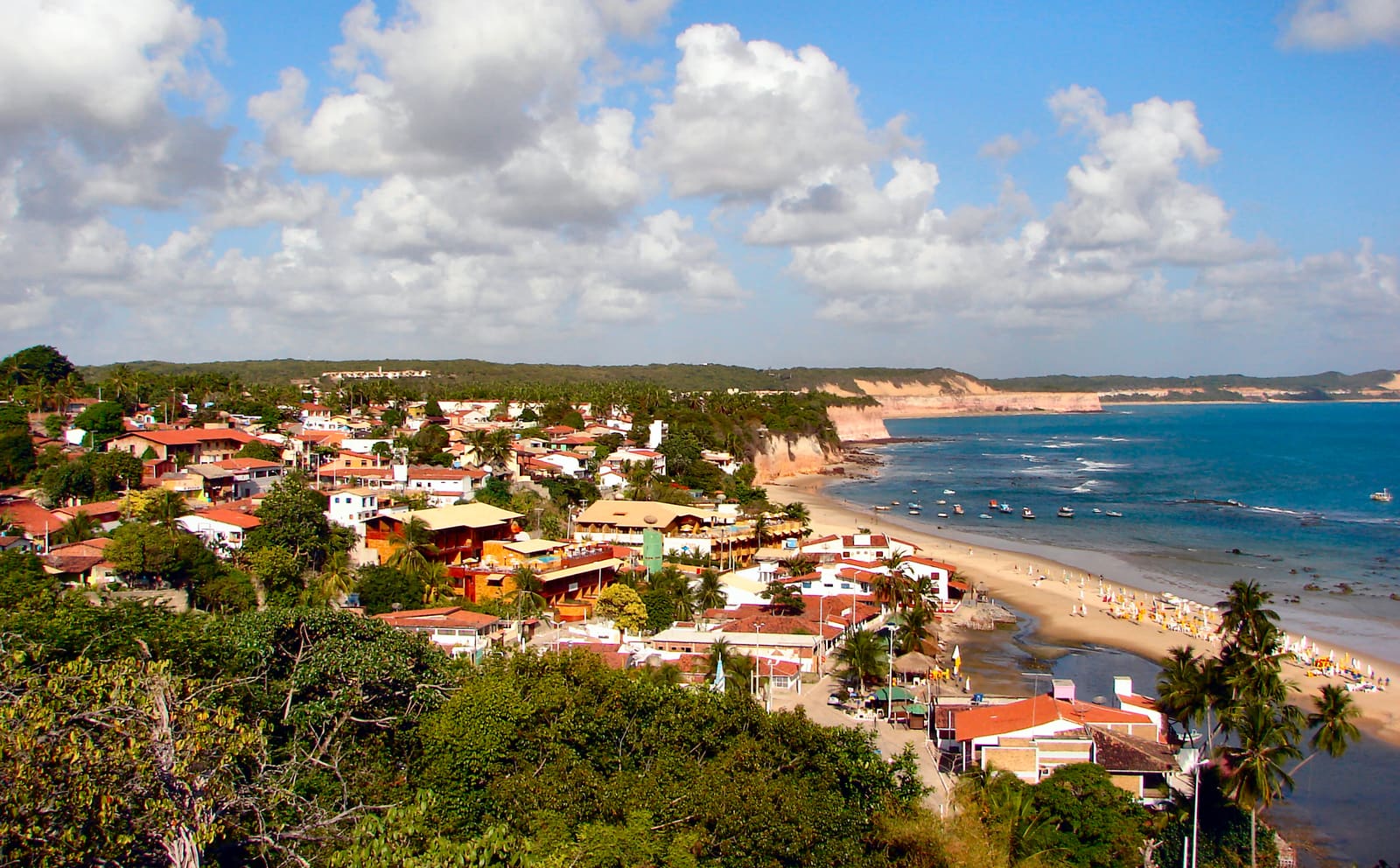
The postcard image of Pipa is its cliffs. At the Chapadão, a reddish wall of up to 40 meters separates Praia do Amor from Praia das Minas and works as a natural lookout for sunrise and sunset, with a view that reaches along the coast as far as Baía Formosa. At low tide, Praia do Amor reveals a heart-shaped formation of rocks on the sand. A 10 to 15 minute walk from Praia do Centro leads to the Baía dos Golfinhos, where gray dolphins feed in calm water; researchers from UFRN, the Federal University of Rio Grande do Norte, chose the spot to study the behavior of the species.
The rest of the day is split between the Atlantic Forest and the nightlife. The Pipa Ecological Sanctuary protects about 90 hectares of forest, with 16 self-guided trails among cliffs and lookouts from which you can watch the dolphins below and, in nesting season, follow the release of baby turtles by the Tamar project. As night falls, the action moves to Avenida Baía dos Golfinhos, the village's main street, with bars, restaurants and nightspots. It is a good contrast with the calm of the beaches during the day.
Updated on October 19, 2026
At low tide, the formation of rocks and sand draws a heart when seen from above, which gave the beach its name. Colorful cliffs, good waves and the Pedra da Pipa, which gives the village its name, are at the far right end.
Reachable only at low tide, on a 10 to 15 minute walk from Praia do Centro. The calm water attracts gray dolphins, which feed there almost every day.
Surfable waves on one side and a calm stretch for swimming on the other, with surf and stand-up paddleboard schools on the sand. The Atlantic Forest covers the back of the beach, and dolphins often show up in the morning.
A reddish cliff of up to 40 meters on the boundary between Praia do Amor and Praia das Minas, with a view of the coast as far as Baía Formosa. It is Pipa's classic spot for sunrise and sunset, with no shade and no facilities.
A private reserve of about 90 hectares of Atlantic Forest and 16 self-guided trails among cliffs. The lookouts let you watch the dolphins below and, in nesting season, the release of baby turtles by the Tamar project.
The most secluded of Pipa's beaches, surrounded by ocher cliffs, with natural pools at low tide and a stretch recognized for naturism. It is also a nesting site for sea turtles.
The village's main street, with bars, restaurants and nightspots. The action starts in the late afternoon and goes on until the early hours.
Already in Tibau do Sul, the lagoon between cliffs and mangrove hosts boat trips in the late afternoon. According to locals, it has the most beautiful sunset in Rio Grande do Norte.
Brazil is in the Southern Hemisphere, so the seasons are the reverse of those in Europe and North America: summer falls between December and March and winter between June and August. The reference climate is that of the Natal weather station, about 80 km away on the same coast. There the change of season is barely noticeable: from December to March highs are 30 to 31 °C and lows 24 to 25 °C, and in July, the coolest month, the average high is 28 °C and the low is 21 °C.
Rain is what makes the difference. The driest months are October, with 21 mm over 5 days, November, with 23 mm over 4 days, and December, with 29 mm over 5 days. The wettest are June, with 349 mm over 18 days, July, with 254 mm over 16 days, and April, with 240 mm over 16 days.
The most favorable window runs from September to December, and November comes out as the best month of the year. The driest and sunniest season runs from September to February, the same as Natal; from March to August it rains more, peaking in June. No month guarantees the weather, but the heat stays all year.
| Month | High | Low | Rain | Rainy days | Rating |
|---|---|---|---|---|---|
| January | 30 °C | 24 °C | 81 mm | 7 | Good |
| February | 31 °C | 25 °C | 100 mm | 8 | Fair |
| March | 31 °C | 24 °C | 201 mm | 13 | Not recommended |
| April | 30 °C | 24 °C | 240 mm | 16 | Not recommended |
| May | 30 °C | 23 °C | 222 mm | 15 | Not recommended |
| June | 29 °C | 22 °C | 349 mm | 18 | Not recommended |
| July | 28 °C | 21 °C | 254 mm | 16 | Fair |
| August | 29 °C | 21 °C | 119 mm | 12 | Fair |
| September | 29 °C | 22 °C | 54 mm | 8 | Good |
| October | 30 °C | 24 °C | 21 mm | 5 | Good |
| November | 30 °C | 24 °C | 23 mm | 4 | Good |
| December | 30 °C | 25 °C | 29 mm | 5 | Good |
Monthly averages for 1991-2020 from INMET (Brazil's National Institute of Meteorology). The rating combines rainfall, temperature and humidity.
In summer (December to February), Pipa has highs of around 30 °C (86 °F) and lows of 25 °C (77 °F), and it is the wetter season, with about 70 mm of rain spread over about 7 days a month. The days are hot and call for beach time and shade.
In fall (March to May), Pipa has highs of around 30 °C (86 °F) and lows of 24 °C (75 °F), and it is the wetter season, with about 221 mm of rain spread over about 15 days a month. The days are hot and call for beach time and shade.
In winter (June to August), Pipa has highs of around 29 °C (84 °F) and lows of 21 °C (70 °F), and it is the wetter season, with about 241 mm of rain spread over about 15 days a month. The days are hot and call for beach time and shade.
In spring (September to November), Pipa has highs of around 30 °C (86 °F) and lows of 23 °C (73 °F), and it is the driest time of year, with about 33 mm of rain a month. The days are hot and call for beach time and shade.
Weather, crowds, prices and what is happening at the destination in each period. Tap a month to open its full page; the colored dot shows how good the time is for a visit.
Carnival takes over the squares and the main street with blocos (street parties) and rhythms ranging from frevo to reggae, in a beach village atmosphere.
The village fills up for New Year's Eve, with parties on the waterfront and in the bars of the main street that run into the early morning.
Recurring annual events: exact dates change every year, so confirm them before you plan your trip.
The nearest airport is Natal International Airport (NAT), in São Gonçalo do Amarante, about 80 km from Pipa. From there the last stretch is by road.
By road, Pipa is 80 km from Natal (about 1 h 30 min, along the BR-101 and the RN-003), 150 km from João Pessoa (about 2 h 10 min) and 250 km from Recife (about 4 h). Routes and airlines change often, so it is safest to check them when you plan your trip.
You do not need a car to get around between the village, Praia do Amor and Praia do Madeiro: you can walk or cycle, so staying in the village or close to it keeps the beaches within reach. Avenida Baía dos Golfinhos is where the bars, restaurants and nightspots are concentrated. For the Chapadão, the Ecological Sanctuary and the boat trip on Guaraíras Lagoon, in Tibau do Sul, a car or an organized tour helps. Pipa and Natal are only 80 km apart and are often combined in the same trip.
Rates change with the dates: confirm the price on Booking.com.
From September to February, the driest and sunniest season in the region, the same window as Natal, which is 80 km away. The most favorable window runs from September to December, with November as the best month (23 mm over 4 days). From March to August it rains more, peaking in June, although the heat stays all year.
Four to five days give you time to see Amor, Madeiro and Minas beaches, walk to the Baía dos Golfinhos at low tide, hike the trails of the Ecological Sanctuary and still enjoy the nightlife of Avenida Baía dos Golfinhos.
They are only 80 km apart and are often combined in the same trip. Natal is the capital, with more infrastructure, the Genipabu dunes and the reefs; Pipa is a smaller village, focused on cliffs, dolphins and a nightlife concentrated on a single street.
You need to go at low tide, when the 10 to 15 minute walk from Praia do Centro is clear. Gray dolphins appear most often in the morning and in the late afternoon, but there is no guarantee, because they are wild animals.
Not for getting around the village, Praia do Amor and Praia do Madeiro: you can walk or cycle. A car or an organized tour helps for the Chapadão, the Ecological Sanctuary and the boat trip on Guaraíras Lagoon, in Tibau do Sul.
Yes. Praia das Minas, the most secluded in the area, has a stretch recognized for naturism, surrounded by cliffs and Atlantic Forest.
The weather and population data in this guide come from official agencies and open databases. Entry requirements and health recommendations change: always check the official source linked.


