
8· 1 review
São Sebastião Whale Watching
São Sebastião offers one of the best spots in Brazil to see humpback whales, making this crossing a must for anyone visiting the region.
4 h
from US$ 102
São Sebastião is worth 4 to 5 days: to see the main beaches from south to north, visit the historic center and take the ferry across to Ilhabela. The driest months run from May to August, with highs of 24 to 26 °C and 74 to 123 mm of rain; summer, from December to March, is hotter and much rainier (up to 313 mm in January).
São Sebastião is the mother town of the north coast of São Paulo: the oldest in the region, founded as early as the 16th century, and the one that lends its name to the whole stretch of coast reaching up to Ubatuba. The municipality spreads over almost 100 km of shoreline cut by the Rio-Santos highway, with dozens of beaches between the Serra do Mar and the ocean. By car you can get from one end to the other in a few hours, but each stretch has its own atmosphere: to the south, lively beaches full of pousadas (small inns); to the north, quieter coves, some almost empty out of season.
The climate is the same as in neighboring Ubatuba, a few kilometers away: humid tropical. The Serra do Mar traps the moisture coming off the ocean and guarantees rain all year. Summer, from December to March, is hot and the rainiest, with quick downpours in the late afternoon; winter, from June to August, is drier and milder, with cleaner water and far fewer people on the beaches. Sunshine is never guaranteed here in any season, but the forest stays green and the waterfalls do not dry up all year.
What you do changes with the stretch of coast. Maresias is the most famous beach: five kilometers of sand, strong waves that host stages of surf championships and a nightlife that turns the beach into a summer hot spot. Farther along the highway, Camburi and Boiçucanga also have waves and shops; Juquehy and Barra do Sahy are more family-oriented, with calm water and kiosks in the shade. The historic center, with the early 17th-century Mother Church and the small Museum of Sacred Art, gets overlooked by most visitors; it is worth a stop before taking the ferry to Ilhabela, which leaves from the waterfront promenade in the center and crosses in a few minutes.
Updated on October 19, 2026
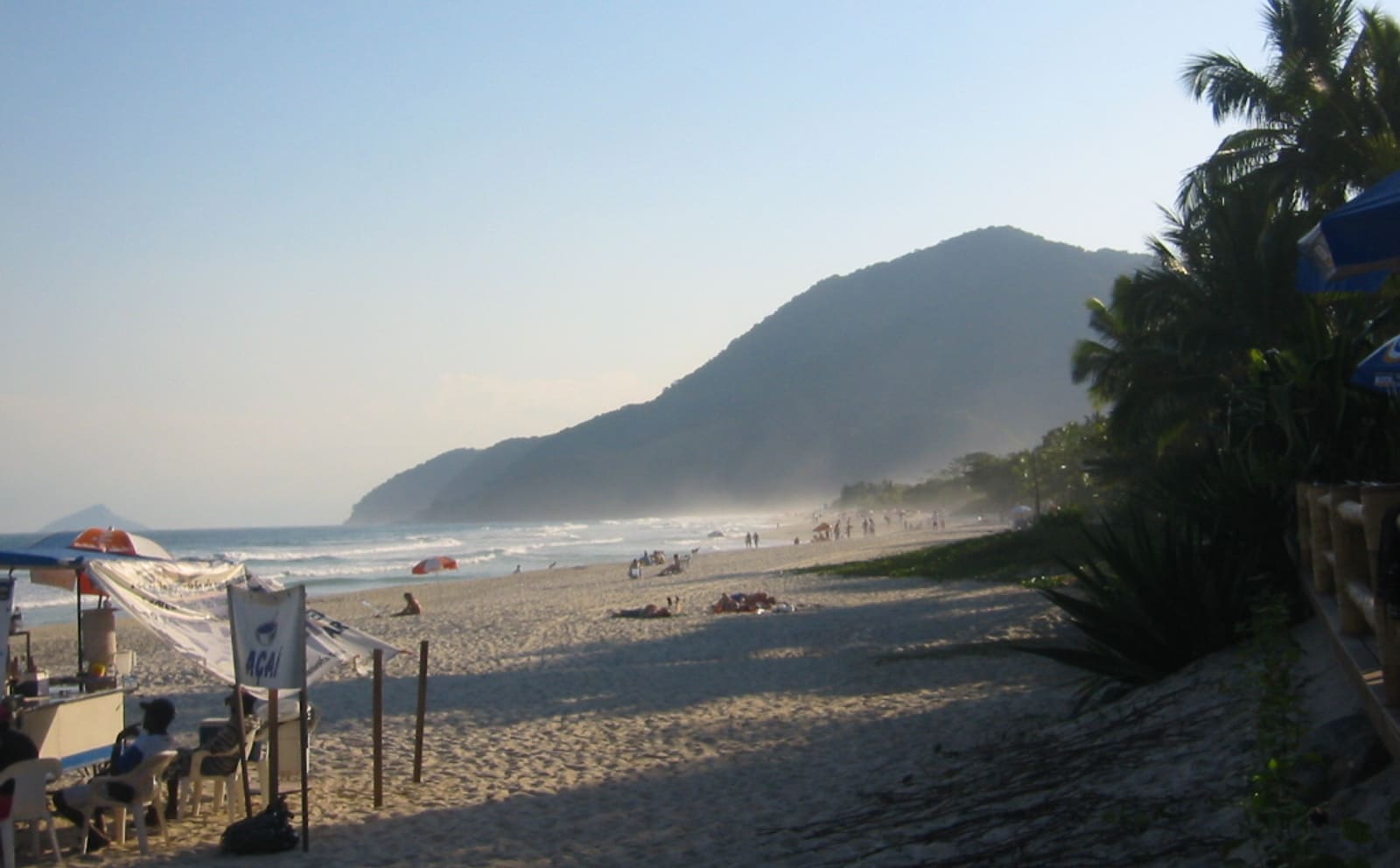
Five kilometers of pale sand and strong surf, one of the most famous surf spots in the country and host of stages of the Banco do Brasil Surf Circuit. At night it turns into a hot spot, with bars and summer parties.
A beach with rough water and good waves, popular with surfers and a young crowd; next to it, Camburizinho has a narrow strip of sand and calm water, a refuge for families with small children.
A horseshoe-shaped cove facing west, with one of the most famous sunsets on the north coast. It is the main commercial center of the municipality's south coast, with a bank, a market and a pharmacy nearby.
Fine white sand along more than three kilometers, with a full range of pousadas and restaurants. The right end has waves for surfing; the left is calmer, good for swimming with the family.
A cove of calm, clear water between rocky headlands, with almond trees shading the sand. The Sahy River flows into the beach under a wooden suspension bridge that leads to the Capela de Santana (Santana Chapel).
Two neighboring coves framed by Atlantic Forest, with a strong caiçara (traditional coastal community) presence: at Toque-Toque Pequeno it is still common to see a fishing canoe come in with the day's catch straight onto the sand.
A seaside colonial core built between 1603 and 1609, with the Mother Church listed as heritage by Condephaat (the São Paulo state heritage council) and the Museum of Sacred Art, in the former Capela de São Gonçalo, with clay pieces found during restoration work on the church.
A crossing of about 20 minutes between the historic center's waterfront promenade and Ilhabela, with departures every 30 minutes.
Brazil is in the Southern Hemisphere, so the seasons are the reverse of those in Europe and North America: summer falls between December and March and winter between June and August. In São Sebastião summer is hot: February is the hottest month, with an average high of 31 °C. In July, the coolest, the high is 24 °C and the low is 14 °C. The reference climate is that of the Ubatuba station.
It rains all year. The rainiest months are January, with 313 mm over 17 days, March, with 311 mm over 16 days, and February, with 291 mm over 15 days. The driest months are August, with 74 mm over 8 days, July, with 93 mm over 8 days, and June, with 94 mm over 7 days.
The window with the least rain runs from May to August, with June having the fewest rainy days: highs of 24 to 26 °C, cleaner water and fewer people. Summer is when the events happen, such as New Year and Carnival, but it also brings the heat and the rain. Since it rains in any month, bring a rain jacket and do not count on guaranteed sun.
| Month | High | Low | Rain | Rainy days | Rating |
|---|---|---|---|---|---|
| January | 30 °C | 22 °C | 313 mm | 17 | Not recommended |
| February | 31 °C | 22 °C | 291 mm | 15 | Not recommended |
| March | 30 °C | 21 °C | 311 mm | 16 | Not recommended |
| April | 28 °C | 19 °C | 233 mm | 13 | Fair |
| May | 26 °C | 16 °C | 123 mm | 9 | Good |
| June | 25 °C | 15 °C | 94 mm | 7 | Good |
| July | 24 °C | 14 °C | 93 mm | 8 | Good |
| August | 25 °C | 14 °C | 74 mm | 8 | Good |
| September | 25 °C | 16 °C | 197 mm | 13 | Fair |
| October | 26 °C | 18 °C | 246 mm | 15 | Fair |
| November | 28 °C | 19 °C | 264 mm | 16 | Fair |
| December | 29 °C | 20 °C | 280 mm | 17 | Fair |
Monthly averages for 1991-2020 from INMET (Brazil's National Institute of Meteorology). The rating combines rainfall, temperature and humidity.
In summer (December to February), São Sebastião has highs of around 30 °C (86 °F) and lows of 21 °C (70 °F), and it is the wetter season, with about 295 mm of rain spread over about 16 days a month. The days are hot and call for beach time and shade.
In fall (March to May), São Sebastião has highs of around 28 °C (82 °F) and lows of 19 °C (66 °F), and it is the wetter season, with about 222 mm of rain spread over about 13 days a month. The days are hot and call for beach time and shade.
In winter (June to August), São Sebastião has highs of around 25 °C (77 °F) and lows of 14 °C (57 °F), and it is the wetter season, with about 87 mm of rain spread over about 8 days a month. Temperatures are pleasant for sightseeing all day.
In spring (September to November), São Sebastião has highs of around 26 °C (79 °F) and lows of 18 °C (64 °F), and it is the wetter season, with about 236 mm of rain spread over about 15 days a month. Temperatures are pleasant for sightseeing all day.
Weather, crowds, prices and what is happening at the destination in each period. Tap a month to open its full page; the colored dot shows how good the time is for a visit.
On January 20, the city celebrates its patron saint with an open-air Mass, a procession and the lowering of the historic 18th-century image.
Besides the blocos (street parties) in the Historic Center, Carnamar takes the celebration out to sea, on decorated boats.
Maresias hosts one of the most traditional stops on the professional surf circuit on the São Paulo coast.
Recurring annual events: exact dates change every year, so confirm them before you plan your trip.
São Sebastião has no regular commercial airport. The nearest one with flights is São José dos Campos Airport (SJK), about 110 km away.
The final stretch is by road. From São Paulo, São Sebastião is 196 km away (about 3 h 30 min) via the Rodovia dos Tamoios, or via the Rio-Santos (BR-101/SP-055) if you are coming from Santos or Ubatuba. From Ubatuba it is 73 km (about 1 h 35 min) and from Santos, 170 km (about 3 h 10 min).
Routes and airlines change often, so it is safest to check them when you plan your trip.
It pays to choose the area according to the type of beach. In the south and center (Boiçucanga, Camburizinho, Barra do Sahy, Toque-Toque) the beaches are calmer and suited to families; Maresias and Camburi have strong waves, surf and nightlife. The ones farthest north, near Boracéia, are already at the border with Bertioga. Since the beaches are spread over almost 100 km of coast, if you want to get around without a car you can stay in the Maresias or Boiçucanga area and use the local bus, although that limits how much you can see.
Rates change with the dates: confirm the price on Booking.com.
Summer (December to March) is hot and is when events happen, such as New Year and Carnival, but it is the most crowded and rainiest. From May to August it rains less, with highs of 24 to 26 °C, cleaner water and far fewer people. It rains all year, so do not count on guaranteed sun in any month.
Yes. Maresias is a beach district of the municipality of São Sebastião, not a separate town: it is the most famous beach in the region, known for surf and nightlife.
The crossing leaves from the historic center's waterfront promenade, runs 24 hours a day, takes about 20 minutes and has departures every 30 minutes between 5:30 a.m. and 11:30 p.m. (overnight the interval rises to one hour). In high season, the line of cars can take hours.
Four to five days is enough to see the main beaches from south to north, visit the historic center and still take the ferry across for a day in Ilhabela. Since the beaches are spread over almost 100 km, if you want to see it all at an easy pace you can stay longer.
They are neighbors on the north coast of São Paulo and have practically identical climates. São Sebastião has Maresias, beaches with more tourist infrastructure and the ferry to Ilhabela; Ubatuba has more trail-access beaches and is even more focused on surf and wild nature. You can visit both on the same trip, since they are about 73 km apart.
It helps a lot. The beaches are spread over almost 100 km of coast along the Rio-Santos, and many of the best, such as Juquehy and Barra do Sahy, are far from the center. Without a car you can stay in the Maresias or Boiçucanga area and use the local bus, but you can cover less ground.
The weather and population data in this guide come from official agencies and open databases. Entry requirements and health recommendations change: always check the official source linked.


