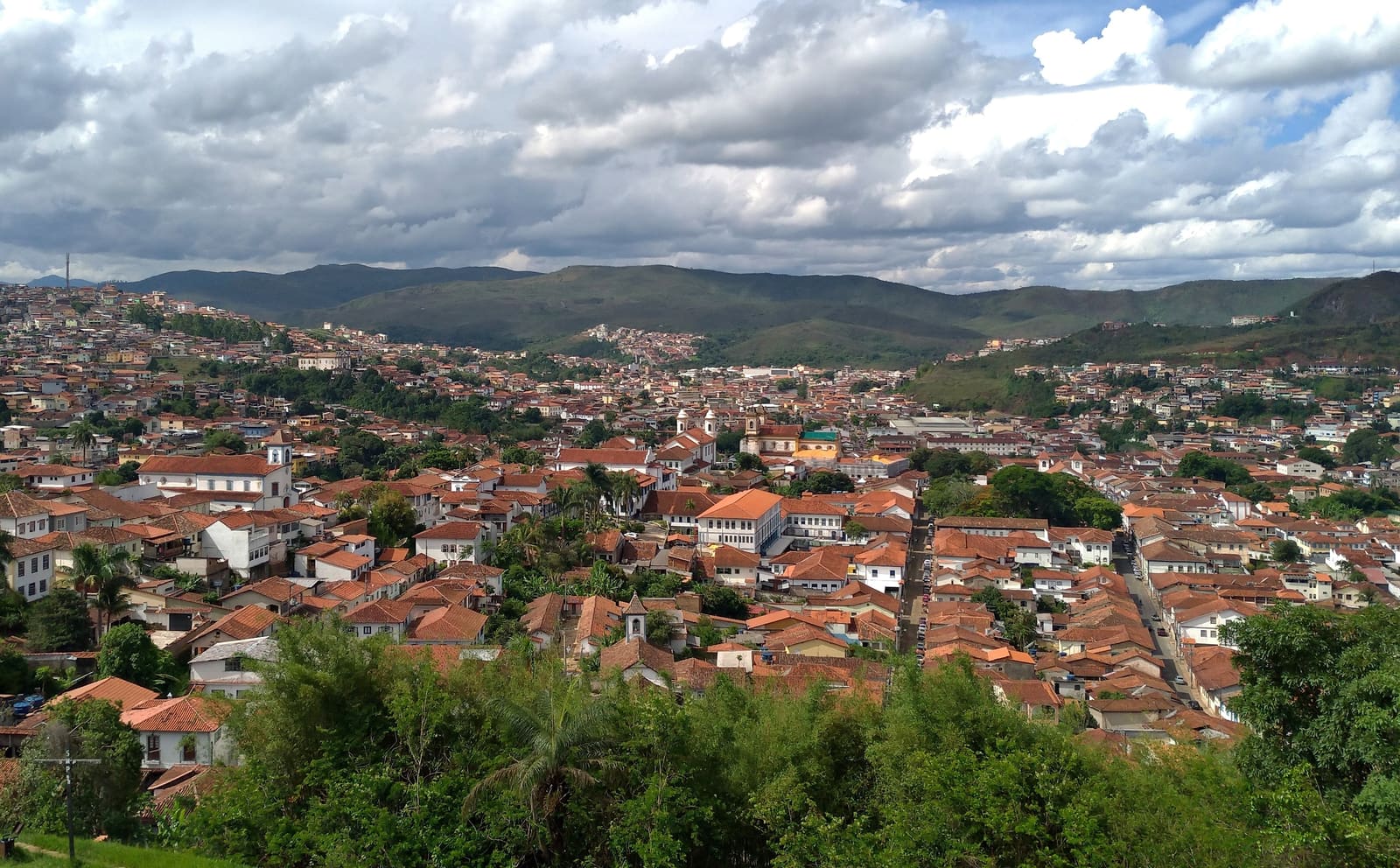
Mariana deserves 2 to 3 days: enough for the historic center and its churches, the Mina da Passagem gold mine, the Trem da Vale tourist train and a combination with Ouro Preto, 12 km away. The driest months run from May to August, with July the driest (5 mm over 1 day) and highs of 25 to 26 °C; summer is wetter and warmer, with 331 mm over 15 days in January and highs of 28 to 29 °C.
What to expect in Mariana
Mariana was the first town, the first capital and the first bishopric seat of Minas Gerais. It was born in 1696, in the settlement that grew on the banks of the Ribeirão do Carmo after bandeirantes (explorers) from São Paulo found gold in the region, and became a city in 1745, named in honor of Queen Maria Anna of Austria. The historic center, a protected heritage site, has one of the best-preserved Baroque ensembles in the country: churches with gilded carving, colonial houses with colorful windows and cobbled streets that climb and drop among the mountains of the Iron Quadrangle (Quadrilátero Ferrífero).
Right next to Ouro Preto, in the mountains of Minas and at an altitude of 712 m, Mariana has the mild climate of the highlands: a rainy, warm summer, from November to March, with heavy downpours in the late afternoon, and a dry, cool winter, from June to August, with sunny days and nights that call for a jacket. The dry season is the most comfortable for walking around the center and tackling the hills; in summer everything turns green, but the stones get slippery.
You explore on foot, without hurrying. Praça Minas Gerais brings together the pillory, the old Town Hall and Jail (Casa de Câmara e Cadeia) and two churches facing each other; the Sé Cathedral holds a German Arp Schnitger organ from 1701, which still gives concerts; the Church of São Francisco de Assis has paintings by Manoel da Costa Ataíde, the master of Minas Baroque, who is buried there. In the surrounding area, the Mina da Passagem opens gold mine galleries to visitors and the Trem da Vale links Mariana with Ouro Preto, 12 km away, on a historic ride along the river. In 2015, the district of Bento Rodrigues was destroyed when a tailings dam burst; the historic city, higher up, remained standing.
Updated on October 19, 2026
Must-sees in Mariana
Praça Minas Gerais
The Baroque heart of the city, with the pillory, the old Town Hall and Jail and the churches of São Francisco and Carmo facing each other.
Sé Cathedral Basilica
Home to a German Arp Schnitger organ from 1701, one of the oldest in the Americas, which is still played in concerts.
Church of São Francisco de Assis
A temple of rich carving with paintings by Manoel da Costa Ataíde, the master of Minas Baroque, who is buried there.
Basilica of São Pedro dos Clérigos
A church with an oval floor plan in the Joanine style, rare in Brazil, set on a lookout with a view over the rooftops of the center.
Mina da Passagem
One of the largest gold mines open to visitors in the world; a trolley descends more than 100 meters to galleries and an underground lake.
Trem da Vale (Mariana–Ouro Preto)
A historic tourist train that covers 18 km along the Carmo River between Mariana and Ouro Preto.
Rua Direita
A street of colonial houses, some visibly tilted by time, with multistory townhouses, workshops and restaurants.
Gomes Freire Garden and Square
A tree-lined square with a lake, a bandstand and bridges, a green breather in the middle of the historic center.
Best time to visit Mariana
Brazil is in the Southern Hemisphere, so the seasons are reversed compared with Europe and North America: summer runs from December to March and winter from June to August. In Mariana summer is mild and rainy, with highs of 28 to 29 °C and lows of 20 °C between December and February, and winter is cool: in June and July, the coolest months, the average high is 25 °C and the average low is 15 °C. The reference climate is that of the Belo Horizonte station, since Mariana has none of its own.
It rains mostly in summer. July is the driest month, with 5 mm over 1 day, followed by June and August (11 mm over 1 day each). December is the wettest, with 339 mm over 17 days, followed by January (331 mm over 15 days) and November (236 mm over 14 days).
For walking around the center and tackling the hills, the best window runs from May to August: sunny days, cool nights and streets without mud. In summer the city turns green, but the stones get slippery, so bring sturdy shoes.
| Month | High | Low | Rain | Rainy days | Rating |
|---|---|---|---|---|---|
| January | 29 °C | 20 °C | 331 mm | 15 | Fair |
| February | 29 °C | 20 °C | 178 mm | 10 | Fair |
| March | 28 °C | 20 °C | 198 mm | 11 | Fair |
| April | 28 °C | 19 °C | 82 mm | 7 | Good |
| May | 26 °C | 17 °C | 28 mm | 3 | Very good |
| June | 25 °C | 15 °C | 11 mm | 1 | Very good |
| July | 25 °C | 15 °C | 5 mm | 1 | Very good |
| August | 26 °C | 16 °C | 11 mm | 1 | Very good |
| September | 28 °C | 17 °C | 49 mm | 4 | Very good |
| October | 29 °C | 19 °C | 110 mm | 8 | Good |
| November | 28 °C | 19 °C | 236 mm | 14 | Fair |
| December | 28 °C | 20 °C | 339 mm | 17 | Fair |
Monthly averages for 1991-2020 from INMET (Brazil's National Institute of Meteorology). The rating combines rainfall, temperature and humidity.
The weather in Mariana, season by season
In summer (December to February), Mariana has highs of around 29 °C (84 °F) and lows of 20 °C (68 °F), and it is the wetter season, with about 283 mm of rain spread over about 14 days a month. The days are hot and call for beach time and shade.
In fall (March to May), Mariana has highs of around 27 °C (81 °F) and lows of 19 °C (66 °F), and it is the wetter season, with about 103 mm of rain spread over about 7 days a month. Temperatures are pleasant for sightseeing all day.
In winter (June to August), Mariana has highs of around 25 °C (77 °F) and lows of 15 °C (59 °F), and it is the driest time of year, with about 9 mm of rain a month. Temperatures are pleasant for sightseeing all day.
In spring (September to November), Mariana has highs of around 28 °C (82 °F) and lows of 18 °C (64 °F), and it is the wetter season, with about 132 mm of rain spread over about 9 days a month. The days are hot and call for beach time and shade.
Mariana in every month of the year
Weather, crowds, prices and what is happening at the destination in each period. Tap a month to open its full page; the colored dot shows how good the time is for a visit.
Recurring events in Mariana
Holy Week (Semana Santa)
Processions, reenactments and sawdust carpets take over the Baroque center in the strongest religious tradition of the Minas Gerais calendar.
Ouro Preto and Mariana Winter Festival (Festival de Inverno de Ouro Preto e Mariana)
Run by UFOP (the Federal University of Ouro Preto), it brings music, theater, film and workshops to the two historic cities in the middle of winter.
Recurring annual events: exact dates change every year, so confirm them before you plan your trip.
Getting to Mariana from abroad
The nearest airport is Tancredo Neves International Airport (CNF), known as Confins, in the Belo Horizonte area, about 161 km away. From there you continue by road. Routes and airlines change often; the safest approach is to check them when planning your trip.
From Belo Horizonte, Mariana is 112 km away (about 2 hours) on the BR-356 (Rodovia dos Inconfidentes), passing through Ouro Preto. From Ouro Preto it is 12 km (less than half an hour) and from Rio de Janeiro, 440 km (about 6.2 hours). You can also go from one city to the other on the Trem da Vale.
Hotels in Mariana
The historic center is explored on foot, so choose lodging near Praça Minas Gerais and the churches, where most of the sightseeing is concentrated. Because the streets are uneven stone and hilly, consider the slope when you choose. Ouro Preto, 12 km away, combines with Mariana in the same itinerary.
Rates change with the dates: confirm the price on Booking.com.
Practical information for visitors from abroad
Frequently asked questions about Mariana
What is the best time to visit Mariana?
The dry season, from May to September, is the most comfortable: sunny days, cool nights and streets without mud for walking. Summer (November to March) is rainy and warmer, with a green landscape but slippery stones.
How many days do you need in Mariana?
Two to three days is enough to see the historic center and the churches, go down into the Mina da Passagem, ride the Trem da Vale and still combine it with Ouro Preto, 12 km away.
Mariana or Ouro Preto?
Both are gems of Minas Baroque and are 12 km apart, so the ideal is to combine them. Ouro Preto is bigger, steeper and livelier; Mariana is smaller, quieter and flat in the center, with the historic organ of the Sé and the Mina da Passagem as highlights.
How does the Trem da Vale work?
It is a tourist train that covers about 18 km between Mariana and Ouro Preto, running along the Carmo River. It usually operates from Friday to Sunday and on public holidays; confirm the schedule and buy tickets in advance in high season.
What is the Mina da Passagem?
It is a former gold mine open to visitors, one of the largest in the world in that format. A trolley on rails descends more than 100 meters deep, to excavated galleries and an underground lake of clear water.
Do you need a car in Mariana?
In the historic center, no: everything is done on foot. A car helps for getting there, for the Mina da Passagem and for combining with Ouro Preto, although the Trem da Vale also covers that route.
Other destinations in Brazil
The weather and population data in this guide come from official agencies and open databases. Entry requirements and health recommendations change: always check the official source linked.